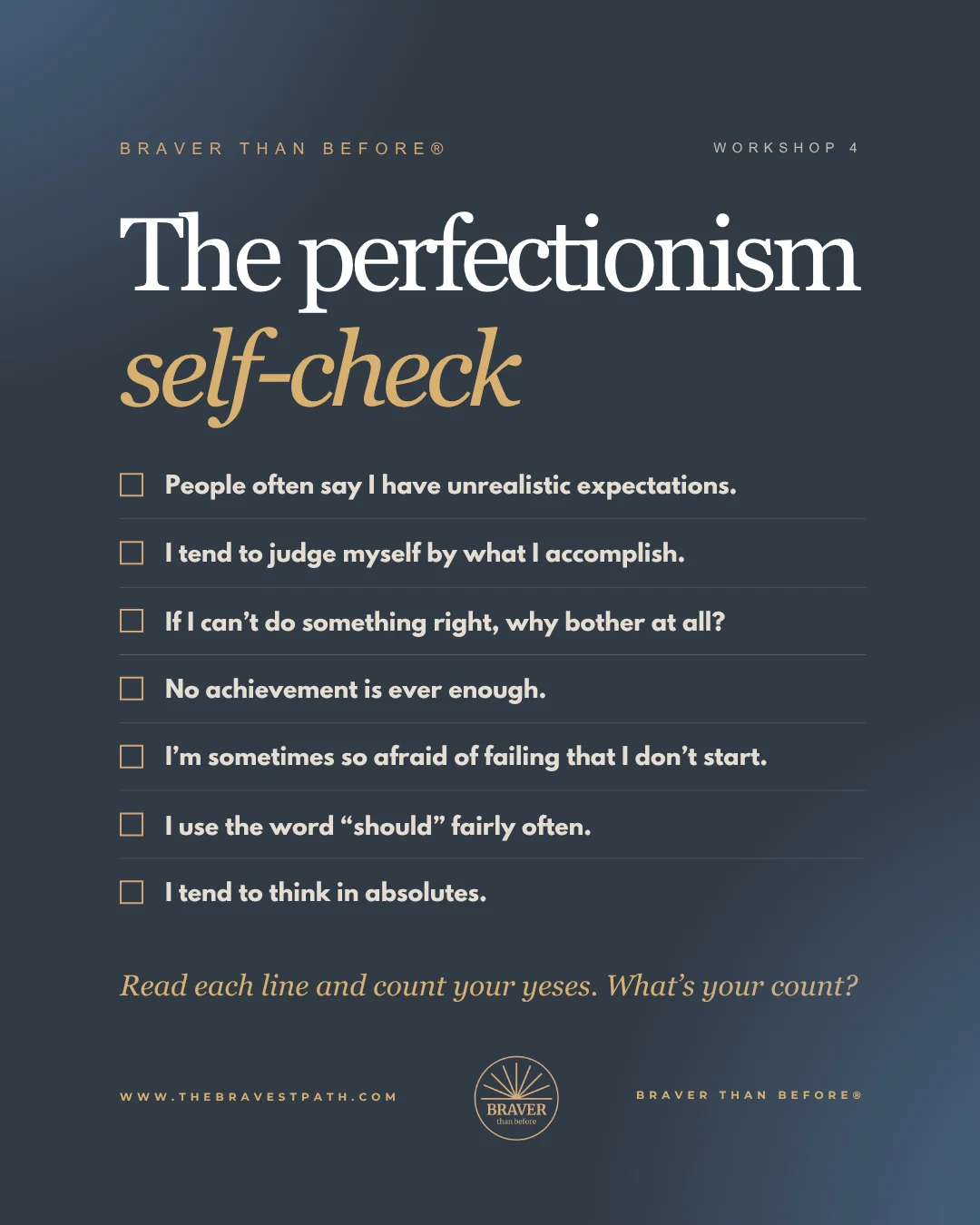
Seven signs of perfectionism from Workshop 4 of Braver than Before®, and what your count is measuring.
Workshop 4 of Braver than Before®, The Courage to Care, begins with what perfectionism is and the situations that trigger it, before participants look at how it shows up in everyday behaviour. Seven of those signs are below, lightly shortened. Read each line and count how many are true of you.
- People often say I have unrealistic expectations.
- I tend to judge myself by what I accomplish.
- If I can’t do something right, why bother at all?
- No achievement is ever enough.
- I’m sometimes so afraid of failing that I don’t start.
- I use the word “should” fairly often.
- I tend to think in absolutes.
There is no pass mark. The self-check is a prompt for reflection rather than a validated scale, and a count of five tells you nothing clinical. What it does is make a habit visible. Most people with a high count have never called themselves perfectionists; they would say they like things done properly.
Why capable people score highest
The highest counts usually come from the most capable people in the room, which makes sense once you see what perfectionism protects. Bréné Brown describes it as the belief that looking perfect and doing everything perfectly will spare us shame, judgement and blame. For someone whose reputation rests on being reliable, that belief pays off for years, and organisations reward it. The director whose board papers never contain a typo and the ward manager who redoes the rota at eleven at night because the layout looked untidy are both praised for the habit that is wearing them down.
The cost shows in the lines about fear. “If I can’t do something right, why bother at all?” and “I’m sometimes so afraid of failing that I don’t start” describe one pattern from two sides: a standard so high that not attempting becomes the safest option. Brown calls this life paralysis, the opportunities we let pass because anything imperfect feels too exposed. In a leadership role it looks ordinary. An improvement proposal stays in drafts for a year while its author waits for it to be bulletproof.
High standards are allowed
Lowering the bar would be the wrong lesson. Plenty of work in healthcare has to be right every time, and a pharmacist who checks a dose twice is doing the job well. Workshop 4 draws the line according to where the effort points, using two questions from Brown. Healthy striving asks “How can I improve?” Perfectionism asks “What will people think?” One question is about the work. The other is about the audience, and it has no finishing point, which is why “no achievement is ever enough” appears on the list.
A useful test: the fourth time you reread an email before sending it, notice which question you are answering. Improving the content is striving. Rewording to pre-empt one person’s reaction belongs to the second question.
Should, always, never
The last two lines are about language, and they tend to be the easiest place to start. “Should” turns a preference into an obligation. Absolutes do something harsher, promoting a single mistake into a verdict: I always get this wrong, I never finish anything properly. In Workshop 5, The Courage to Keep Going, “I should, I ought to, I wish I had” returns as the voice of the Inner Critic. Try counting the shoulds in your next team meeting, starting with your own.
Bringing the number down
The second half of Workshop 4 turns to self-compassion, using Dr Kristin Neff’s three components: mindfulness, noticing that you are struggling without exaggerating or dismissing it; common humanity, the recognition that everyone makes mistakes; and self-kindness, offering yourself the understanding you would give someone else.
The workshop also names five common barriers to self-compassion, and one of them will be familiar to anyone with a high count: the worry that being kinder to yourself will cost you your motivation. The research points the other way. Self-compassion is associated with less fear of failure, and in experimental studies it has increased people’s motivation to improve after a mistake.
The prompt participants practise is plain. How would I speak to a friend who had done this? Most high scorers already know the answer, because they give it to their teams every week.
Sources
Brown, B. (2010). The Gifts of Imperfection. Hazelden. Source of the definition of perfectionism, the phrase “life paralysis”, and the distinction between healthy striving and perfectionism.
Neff, K. (2011). Self-Compassion: The Proven Power of Being Kind to Yourself. William Morrow. Source of the three components of self-compassion. self-compassion.org
Neff, K. D., Hsieh, Y. P., & Dejitterat, K. (2005). Self-compassion, Achievement Goals, and Coping with Academic Failure. Self and Identity, 4(3), 263–287. tandfonline.com
Breines, J. G., & Chen, S. (2012). Self-Compassion Increases Self-Improvement Motivation. Personality and Social Psychology Bulletin, 38(9), 1133–1143. pubmed.ncbi.nlm.nih.gov
About Braver than Before®
Braver than Before® is a courage-building programme for leaders: six progressive workshops covering vulnerability, brave conversations, speaking up, self-compassion and resilience, equivalent to 30 hours of CPD. 91% of graduates are more likely to speak up after the programme, and 96% report increased confidence to act when something needs to change. The next cohorts, Nova and Onward, begin in March 2027.